Turning a translation deadline into a shared library
After translating a six-page journey into Arabic by hand, I proposed a shared English–Arabic UX writing library in Emirates NBD’s design system. With Figma AI mapping screens to it, translating a large journey could drop from about 8 hours to 1 hour of review.
Overview
Emirates NBD’s copywriters keep approved English and Arabic copy aligned, and the bank has official UX copy guidelines. But getting that copy into a design still meant finding the right line, pasting it into Figma and repeating that on every screen.
I proposed putting that copy inside the design system itself, so designers could pull it straight into their screens and switch them to Arabic. The design system team built it, and Figma AI now does the matching.
The problem
It started with a deadline. I had to translate a product team’s journey into Arabic quickly. It ran to hundreds of screens across six Figma pages, and the terminology had to match our UX writing guidelines throughout.
The copy existed. It lived in an Excel sheet and in the guidelines. The slow part was everything around it: searching for the right line, pasting it in, checking it matched, one screen at a time. Slow, hard to search, and easy to get inconsistent.
Where the idea came from
I had worked with the ATM team’s translation library before. There, I could switch recurring copy over in one go and only review what was missing.
That made me ask: could we offer the same thing at design system level, so every product team benefits?
If copy is reused, or likely to be reused, it belongs in the library.
My role
- Proposed the library at design system level, based on the ATM team’s approach.
- Supplied the approved English and Arabic copy the library is built from, aligned by our copywriting team and checked against the UX copy guidelines.
- Co-wrote the internal article that introduced the library to the bank’s design team.
The library itself was built with the design system team. A senior product designer designed its structure, a product designer migrated the copy into Figma variables and reviewed the Arabic as a native speaker, and the design system lead backed the idea and guided the setup.
How the library is organized
The structure matches the bank’s existing design system libraries, with two levels:
- Core copy that should stay the same across products: buttons, actions, validation messages, errors and confirmations.
- Flows, a more flexible space where teams add journey-specific headlines, descriptions and instructions.
The content came from two Excel files of copy already aligned across teams, plus an approved account-opening journey.
Where AI comes in
Translation libraries had been tried before, and adoption was always the problem. Nobody wants to search through hundreds of variables and connect text layers one by one.
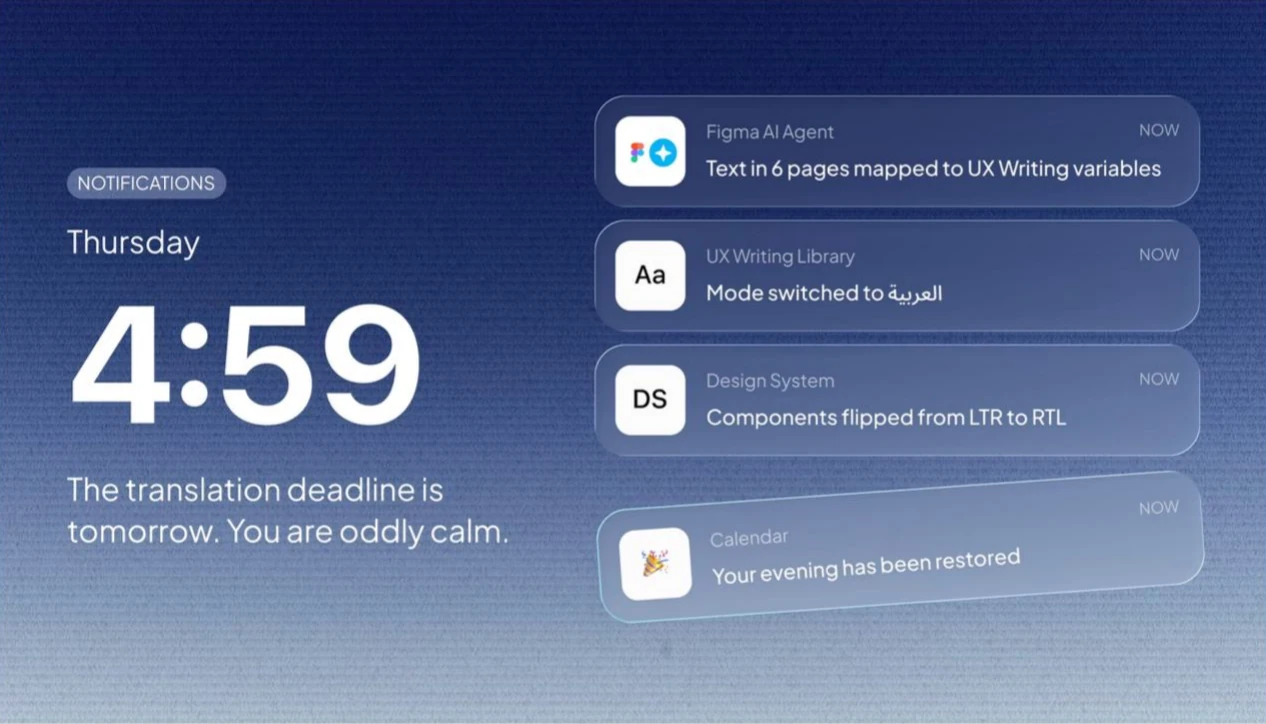
Now a designer can select a page, a section or a whole flow and ask Figma AI to map its text to the right UX writing variables. AI handles the repetitive matching. Designers and copywriters spend their time on what needs judgement: unique copy, context, tone and the final review.
How it works now
- Design the journey as usual.
- Ask Figma AI to map the copy to UX writing variables.
- Switch the language mode from English to Arabic. Design system components flip from left-to-right to right-to-left.
- A copywriter reviews the remaining copy and translates only what’s unique.
- Hand over the translated, reviewed design.
For a large journey, the team estimates this could cut translation from around 8 hours of copying and pasting to about 1 hour of review.
What’s next
This is phase one. Next, the team wants to make contributing simple, possibly through a Figma plugin or a dedicated tool, so copywriters can add flows, maintain translations and introduce new languages without touching variable structures.
The team also wants to see whether the same variables can carry through to development, so approved terminology is shared from design all the way to the live product.